Designing Politically Feasible Congestion Pricing
Why is good policy so hard to implement? Many of the policies we believe would improve welfare have a “free lunch” element: their benefits are not just distributional, moving resources from one pocket to another; they create surplus by the behavior they induce. The winners gain a lot more than the losers lose. Vaccine subsidies, upzoning, and carbon pricing are a few examples. A policy from this family, often endorsed by economists, is congestion pricing: beyond funding transportation improvements through the tolls drivers pay, its main benefit is reduced traffic, yielding cleaner air, shorter commutes, and quieter, more walkable streets. However, congestion pricing is also notorious for being politically toxic. In a recent paper, I argue that people are less likely to support congestion pricing and similar policies precisely because so much of their benefit—the “free lunch” element—comes from their equilibrium effects.
Voters Are Over-Pessimistic About the Effects of Congestion Pricing
Consider the following quote from Todd, a resident of Northborough, MA:
How, exactly, will charging workers more on their commute reduce congestion? This is just another money grab by the state. Most people commuting are doing so for a reason — their employers demand they be at work at specific times. This seem[s] more like punishment for having a job in Boston than a means to reduce traffic. And just what will the state do with the revenue collected? Give themselves another 20% raise?
Todd is focused on the direct effect of congestion pricing: those who drive would have to pay a toll (a “money grab”). He neglects—and in fact explicitly rejects—the notion that the toll will also have an equilibrium effect: fewer cars, less pollution, faster commutes. This phenomenon, which I call equilibrium neglect, can explain various empirical regularities in public opinion, among them persistent support for rent control and skepticism toward market-based tools for reducing emissions. Dal Bó, Dal Bó, and Eyster (2018) show the mechanism cleanly in the lab: subjects vote for policies that are harmful once behavioral responses are accounted for.
What happens to people like Todd once they get first-hand exposure to congestion pricing? Consistently, we see that many of them change their minds. Figure 1 collects publicly available opinion polls from cities that implemented congestion pricing, before and after implementation.
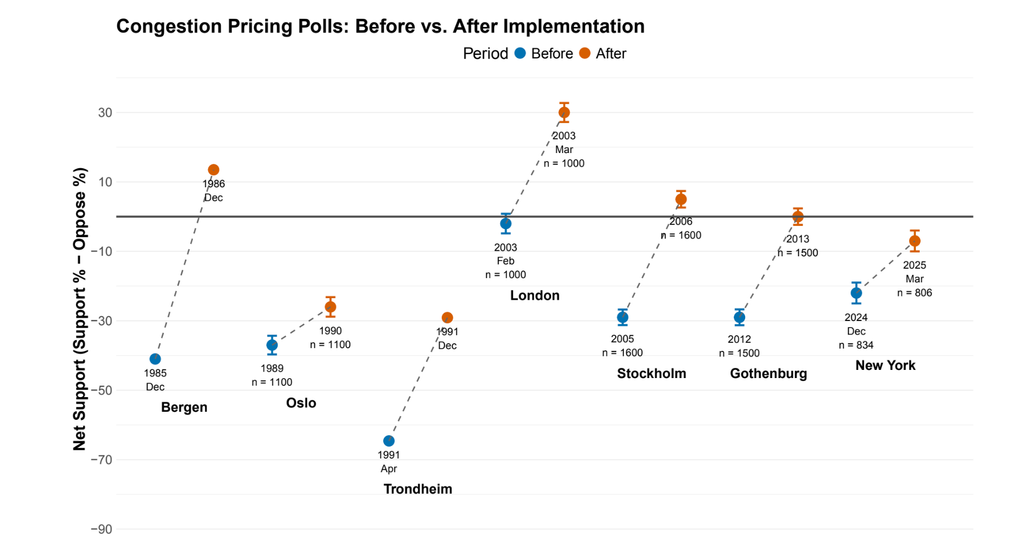
Note: Each pair of dots shows net support for congestion pricing (percent who support minus percent who oppose) in a city’s polls before (blue) and after (orange) the toll was introduced. Labels give the poll date and number of respondents; vertical bars show the margin of error where available. Support rose after implementation in all seven cities. Source: Dreyfuss (2026), based on publicly available polls.
This pattern is what we would expect if people are over-pessimistic about the effects of the policy, so that part of the opposition dissipates once the benefits are visible. Carattini et al. (2026) document this channel directly: In their own survey, they find a similar increase in support for congestion pricing in New York City after its implementation, and show that New Yorkers were pleasantly surprised by the policy’s effects on travel time, pollution, noise, and traffic accidents (all consequences of fewer cars): About 26–32% of NYC respondents said they were surprised by these improvements, roughly double the share elsewhere in the U.S. (14–16%).
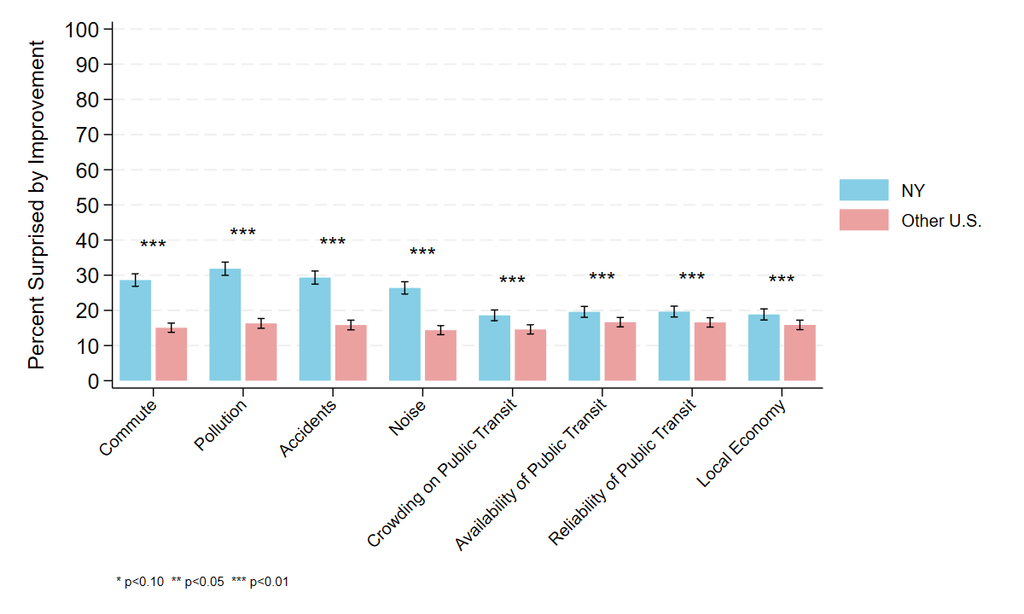
Note: Share of respondents who say they were surprised by improvements in each area since New York introduced congestion pricing, among New York residents (blue) and residents of other U.S. areas (red). Source: Carattini et al. (2026).
This suggests that congestion pricing generates spurious opposition: people who benefit from the policy but do not support it because they under-appreciate its positive equilibrium effects.
It seems that if we could only expose people to the policy, it would become far less politically toxic. More often than not, though, we get stuck at the “before” level of support (the blue dots in Figure 1) which is simply not enough to move the policy forward.
Of course, if we could convince people like Todd with evidence that charging drivers reduces congestion, this would address much of the problem. But some people’s beliefs are persistent, and exposure to evidence does not always lead to stable changes in them.
A Guarantee (Not a Rebate)
I propose an approach that does not rely on persuasion. What worries people like Todd is that others will keep driving even with a toll in place. So why not write that worry into the policy? Alongside the toll, we can promise all downtown workers ‘traffic compensation, paid in any month in which traffic remains high—regardless of how they commute. The policy becomes a win-win: either the commute gets faster, or you get paid.
It is tempting to call this a “money-back guarantee,” and the analogy is useful as far as it goes. But it is important to note that the compensation is not a refund of the toll. In particular, eligibility for compensation must not depend on paying the toll, or on driving at all; if it did, the policy would be encouraging people to drive, and could potentially undo the traffic reduction the toll is meant to produce.
It is also not simply an unconditional payoff to drivers. If the toll works as economists expect it to, congestion falls, the condition is never triggered, and nothing is ever paid. What the policy offers is essentially insurance or a warranty against the world Todd is worried about—high toll and high congestion—but it is fiscally free in the world where he turns out to be wrong. I also show in the paper that we can make it self-funding in the world where Todd turns out to be right and we need to compensate him: high congestion means high toll revenue, which arrives exactly when the compensation is due.
Can Traffic Compensation Increase Public Support?
My paper tests this conjecture using an opinion poll of 2,056 people living in one of six US metros (Boston, Chicago, Dallas, Los Angeles, San Francisco, and Washington DC). Respondents first evaluated a standard congestion pricing proposal, which — as in most polls — drew strong opposition (-43 net support points). A randomly selected group then saw the proposal again with the traffic compensation added; the rest saw it essentially unchanged. Comparing how support moved across the two groups, Figure 3 shows that the compensation raises net support by about 9 points in the population as a whole, and by about 40 points among the people it targets: those who commute to work downtown.
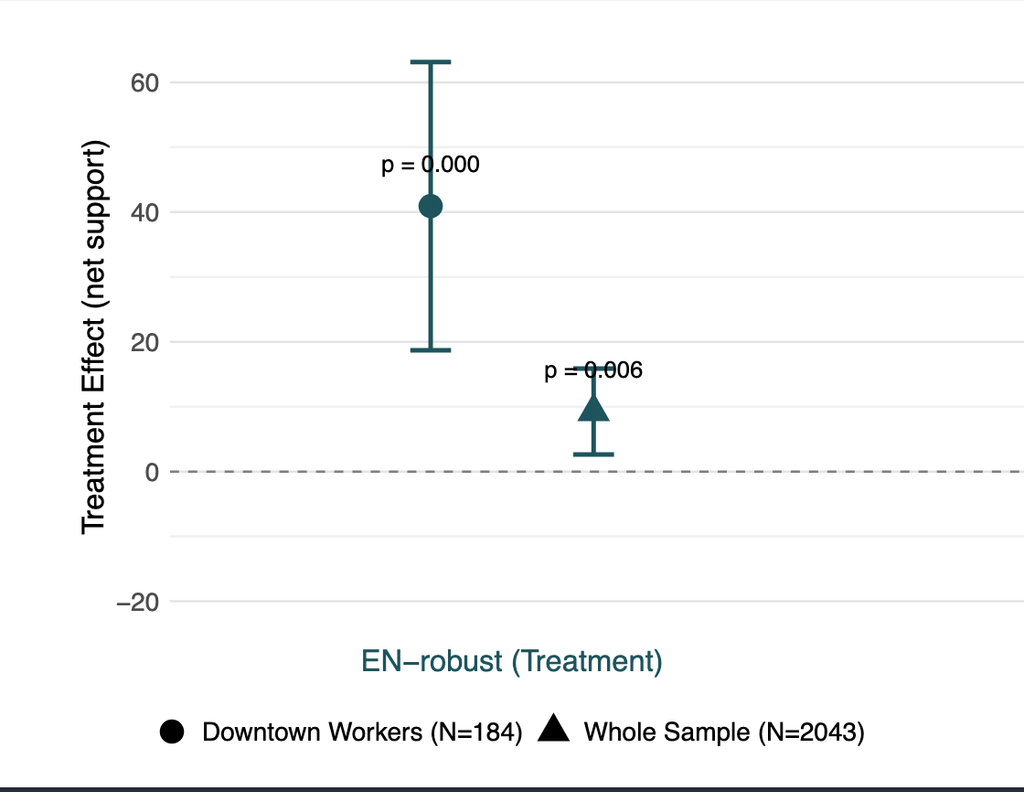
Note: Increase in net support (percent who support minus percent who oppose) caused by adding traffic compensation to the congestion pricing proposal, comparing respondents randomly shown the compensation with those who were not. Circle: people who work downtown; triangle: all respondents. Vertical bars show the margin of error. Source: Dreyfuss (2026).
On top of providing information in order to change people’s minds, rethinking the design of our policies can also be an effective tool.
What Do Elected Officials Think?
Even if a policy tool is popular among the public, elected officials may not recognize that it is. They may also object to it for other reasons: they may perceive administrative costs to be too high, or the goal to be low priority. To assess whether the idea resonates with elected officials, I surveyed 117 state legislators and 211 local elected officials (council members and mayors) from municipalities with at least 50,000 residents. I showed them the standard version of congestion pricing and the version that includes traffic compensation, and asked them for both their own level of support and their estimate of public support.
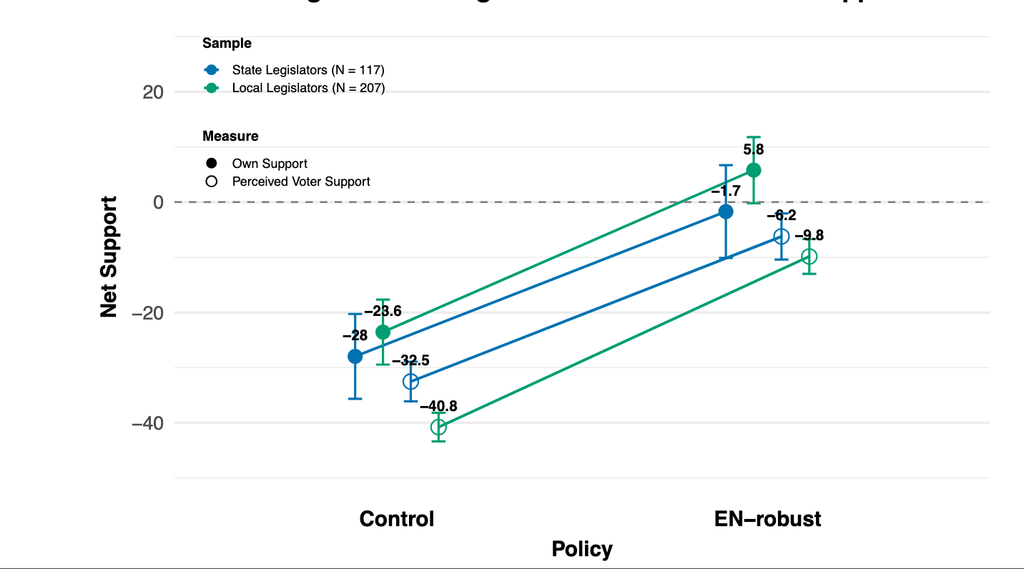
Note: Net support (percent who support minus percent who oppose) among state legislators (blue, N = 117) and local elected officials (green, N = 207) for the standard congestion pricing proposal (left) and the proposal with traffic compensation (right). Filled circles show officials’ own support; hollow circles show how much support they expect from their voters. Vertical bars show the margin of error.Source: Dreyfuss (2026).
Elected officials recognize that congestion pricing is unpopular, and that the contingent compensation can help increase its support. This translates into much higher levels of support among the officials themselves, suggesting that the increase in public support is anticipated by politicians, and translates into political appeal.
Constrained Policy Design
Whether this or any similar idea would ever be implemented in practice remains to be seen. But at the very least we should hope for a continued development of public policy that takes into account the political constraints imposed by voters’ beliefs and preferences, and narrows the gap between what is optimal and what is politically feasible.
References
Carattini, Stefano, Hall, Jonathan, Ockenfels, Axel, Schmidt, Klaus, and Vora, Ravi, “The New York Congestion Charge.” Working paper.
Dreyfuss, Bnaya. “Equilibrium Neglect and Political Feasibility.” Working paper.